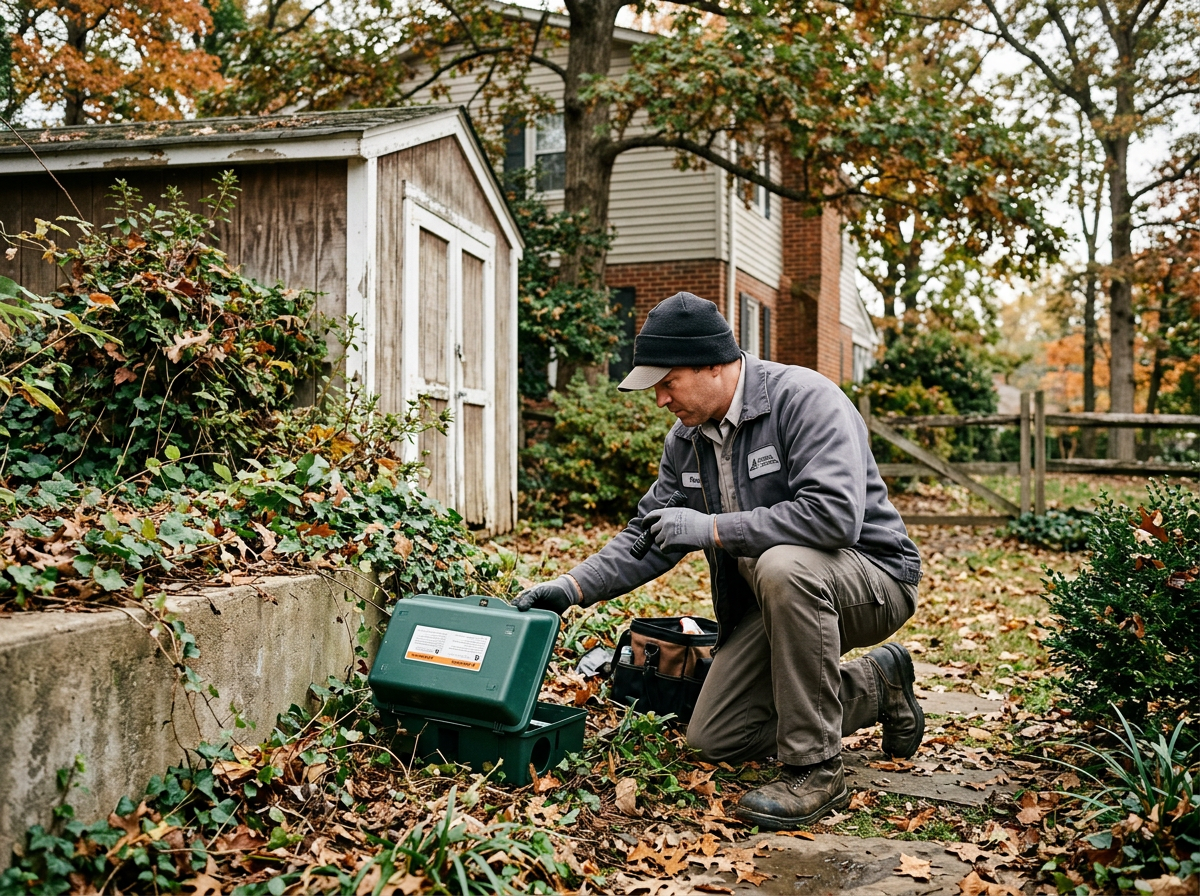
Rats in Midlothian homes commonly harbor in crawlspaces where clay soil retains moisture and creates damp conditions under pier-and-beam foundations common in 1970s-1990s subdivisions. They also use gaps around utility penetrations, garage door thresholds, and soffit vents to reach attics where insulation provides nesting material. Day-to-day work starts with mapping every potential opening larger than a dime, then installing metal mesh or concrete patch before any trapping begins because new rats will simply replace the ones removed.
Baiting programs alone fail here when homeowners place stations without first closing access routes; rats quickly associate the stations with danger and shift activity to neighboring properties or untreated voids. Technicians spend most of a visit on hands-and-knees inspection of foundation skirts and deck ledger boards rather than scattering bait. Limits appear quickly when an adjacent lot has dense ivy or unmaintained sheds that serve as constant reservoirs.
Work succeeds only when every identified entry is addressed the same day and follow-up trapping confirms no new activity for at least two weeks. Interior trapping uses covered snap traps along walls rather than loose bait that can be carried away. Persistent issues usually trace back to unsealed dryer vents or roof flashing on split-level homes along routes like Midlothian Turnpike.
Technician insight
In Midlothian, the thing that catches most people out with Rat Removal is how the clay-heavy soil and frequent summer rains drive rats straight to the unsealed foundation vents on 1980s ranch homes off Powhatan Parkway.
Crawlspace Entry in Midlothian Split-Level
Rats were reaching the kitchen nightly through gaps around the dryer vent and water line. Inspection found active runways under the pier-and-beam crawlspace typical of the neighborhood. Crew sealed every opening with metal mesh and concrete, then set covered traps along the foundation wall. Activity stopped within ten days and no new signs appeared on the follow-up visit.
Rat Removal Services We Offer
✓Entry Point Exclusion and Sealing
Locate and permanently close all gaps around foundations, utilities, and rooflines using rodent-proof materials to stop new rats from entering.
✓Comprehensive Rodent Inspection
Full property walkthrough that identifies active runways, droppings, and harborage sites specific to Midlothian crawlspaces and attics.
✓Interior Trapping Programme
Strategic placement of covered traps along interior walls and known pathways to remove rats already inside the structure.
✓Crawlspace Rodent Treatment
Targeted trapping and debris removal in damp crawlspaces where clay soil and standing moisture attract rats under local homes.
✓Garage and Perimeter Bait Stations
Installation of secured stations along exterior walls and garage interiors to intercept rats before they reach living spaces.
How it works
- 1
Detailed Inspection
Technician examines foundation, attic, garage, and yard for entry points and current activity.
- 2
Exclusion Work
All identified openings are sealed with steel wool, mesh, and caulk or concrete.
- 3
Trapping Deployment
Covered snap traps and stations are placed along confirmed runways inside and on the perimeter.
- 4
Follow-Up Visits
Return checks remove trapped rats and confirm no new activity before closing the job.
Pricing
Scope depends on the number of entry points found and whether attic or crawlspace access is required. Call for an inspection and quote.