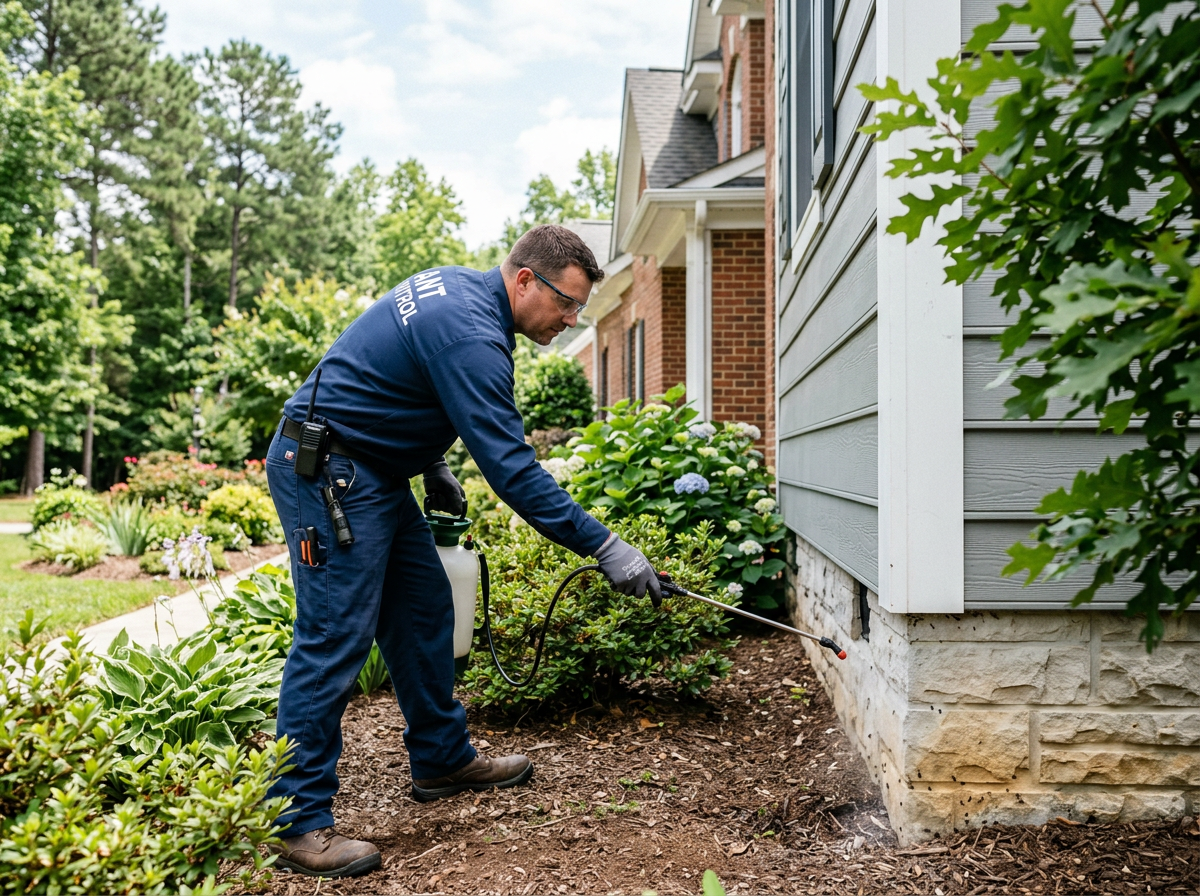
Fire ants have spread into southeastern Virginia lawns and are now appearing in Chesterfield County yards around Midlothian. These ants build mounds in sunny turf and along foundation edges where clay soil holds moisture after rain. Technician work starts with locating active mounds and satellite colonies rather than broadcast spraying, because mounds quickly reappear when only the surface is treated. Perimeter barriers must reach shaded soil under shrubs and behind retaining walls where workers travel between nests.
Carpenter ants in Midlothian homes commonly nest in older deck posts, fascia boards, and moisture-damaged window frames common to 1980s and 1990s subdivisions. The real job involves tracking foraging trails back to the parent colony, often inside soffits or crawl-space timbers, then applying targeted bait and dust rather than perimeter sprays that miss the interior nest. Homeowners often see scattered workers and assume a simple spray will finish the problem, yet untreated parent colonies send out new foragers within days.
Ant control fails when bait is placed where competing food sources exist or when irrigation keeps soil too wet for granules to stay active. In Piedmont clay, water sits in low spots and creates secondary nesting sites that a single treatment cannot reach. We map irrigation patterns and mulch beds during the initial inspection so follow-up visits focus on the actual travel routes instead of treating the entire yard again.
Why Source Inspection Matters More Than Spraying
Virginia ants rarely stay in one visible mound. Without locating the parent colony in decks, crawl spaces, or neighboring lots, any surface treatment only reduces numbers temporarily. Our process identifies these hidden sites first so the program addresses the actual population rather than repeated visible activity.
Technician insight
In Midlothian the thing that catches most people out with ant control is the clay soil and frequent summer storms that keep low spots wet long enough for new fire ant colonies to start right next to the ones we just treated. Homeowners keep spraying the same visible mounds while the real parent sites sit under the neighbor's fence line or behind the irrigation heads.
Midlothian Backyard Fire Ants
Homeowner reported recurring mounds along the patio and side yard. Inspection found the main colony under a neighbor's fence line where water pooled after rain. We treated the active mounds on the property and placed bait stations along the shared edge. New activity stopped within ten days and stayed down through the rest of the season.
Ant Control Services We Offer
✓Fire Ant Mound Treatment
Direct mound injection and surrounding soil treatment that targets established colonies common in southeastern Virginia lawns.
✓Carpenter Ant Control
Trail tracking and nest treatment inside decks, fascia, and crawl spaces where carpenter ants nest in Midlothian housing stock.
✓Perimeter Ant Barrier
Targeted application along foundations, mulch beds, and shaded soil routes that ants use to enter structures.
✓Indoor Ant Nest Location
Inspection and treatment of interior colonies in walls, under slabs, or within older home framing.
✓Ant Bait Station Programme
Placement and monitoring of stations that carry bait back to hidden colonies for longer-term reduction.
✓Seasonal Ant Prevention
Spring and summer visits timed to local rainfall patterns that trigger new mound formation.
How it works
- 1
Site Inspection
Technician walks the full property, checks foundation, decks, turf, and neighboring edges for active mounds and foraging trails.
- 2
Nest Mapping
Trails are followed to locate parent colonies in soil, wood, or voids so treatment reaches the source rather than scattered workers.
- 3
Targeted Application
Bait, dust, or mound drench is applied directly to active sites and travel routes based on the inspection findings.
- 4
Follow-Up Visit
Second visit checks for new activity and adjusts placement after weather or irrigation changes.
Pricing
Scope depends on property size, number of active mounds, and whether colonies are inside structures or on adjacent lots; we provide an exact quote after the inspection—call to schedule.